The Empathy Deficit in Marketing, and How to Fix It
TL;DR
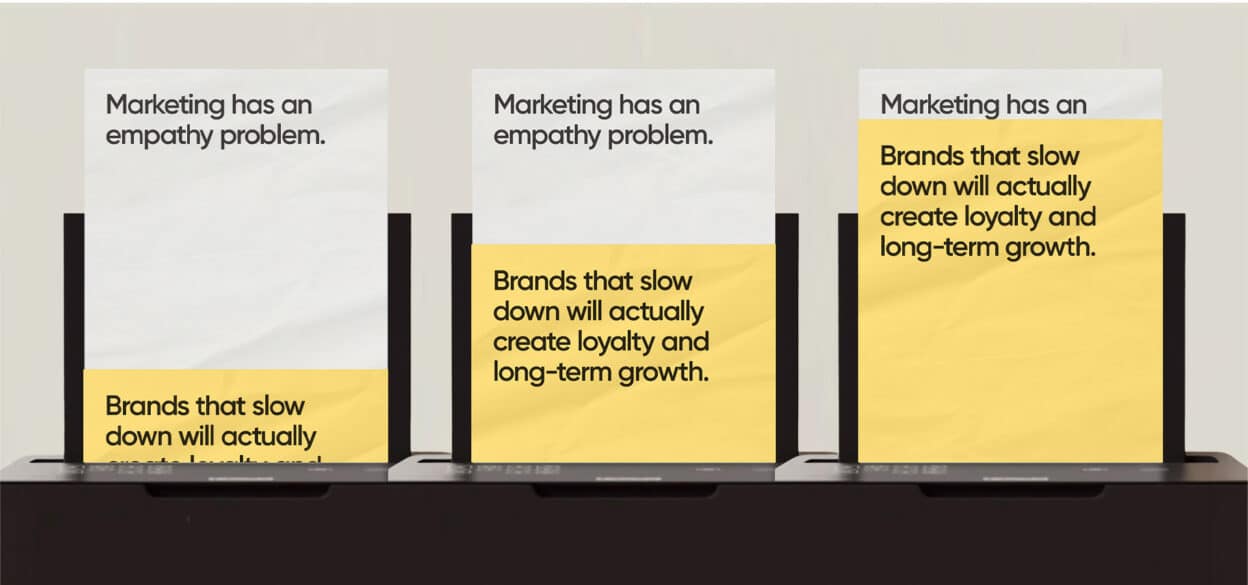
Marketing has an empathy problem: brands are optimizing for speed, automation, and dashboards while neglecting the human realities behind the data. Brands that slow down will actually create loyalty and long-term growth.
- Posted on
- Mar 11, 2026
- Read time
- 6 min
Despite having more data and insight tools than ever, much of today’s marketing feels hollow. Learn how you can translate customer-centered empathy into real business results.
We are living through an empathy decline. This isn’t abstract or a matter of opinion. It is a measurable cultural shift. You can see it in our politics, our social feeds, and our workplaces. We have replaced listening with reacting, and flattened genuine understanding into lazy assumptions.
The world of marketing/branding has accelerated this race to the bottom. Despite having more data and insight tools than ever, much of today’s marketing feels hollow. Brands talk constantly, but they rarely listen. They optimize for speed and efficiency while abandoning the harder work of actually understanding the people on the other side of the screen. The result is marketing that may look fine on a dashboard but is completely forgettable in real life.
This is the empathy deficit. When you constantly prioritize metrics and data over human understanding, you do not just lose engagement, you lose trust. And as research highlighted by Harvard Business Review shows, that loss has a real price. Higher organizational empathy is directly linked to stronger earnings and valuation gains. Empathy is more than a soft skill; it is a real business lever.
What empathy actually means in marketing.
Empathy isn’t a buzzword, a tone of voice, or a campaign theme. It’s not “being nice,” and it’s not pretending to care.
In a marketing context, empathy means doing the uncomfortable work of seeing the world through your audience’s eyes, not as you wish they did, or as your personas suggest they should.
That includes:
- Standing in the customer’s shoes: Understanding real pressures, fears, tradeoffs, and unspoken tensions, not just stated needs.
- Understanding context, not just personas: Recognizing that decisions are shaped by environment, culture, time pressure, and risk.
- Designing for emotional impact: A message’s emotional resonance often matters more than its cleverness.
- Admitting difference and vulnerability: Brands that show humility and curiosity earn more trust than those that posture as experts in worlds they haven’t lived in.
Empathy actually complicates the marketing process, and that’s exactly why it works.
Radical curiosity in practice: listening before leading.
We have seen the power of empathy most clearly in our work with Merillat Cabinetry and Lake Trust Credit Union, two very different organizations facing very different challenges.
In the kitchen and bath industry, marketing often defaults to the homeowner’s “dream kitchen” narrative. It is familiar, safe, and largely interchangeable. When we stepped into the daily reality of Merillat’s true customers, kitchen dealers and designers, a different truth emerged.
By asking “What are we missing?” we learned these professionals were not looking for inspiration. They were looking for a partner who understood the pressure of a job site, the risk of a failed install, and the reputational stakes of getting it wrong. That insight goes beyond data models or persona workshops. It’s uncovered by listening to what we didn’t know and letting their world reshape the strategy. By prioritizing the dealer’s success over generic lifestyle storytelling, we earned trust with their true customers.
We applied the same listening-first approach in our work with Lake Trust Credit Union, but at a different scale and in a different context. At the start of that engagement, we conducted a listening tour across all 22 branches statewide, spending time with both staff and members in their local communities.
What we heard was consistent. People did not just want financial services. They wanted to feel seen, supported, and empowered. Those local perspectives helped shape a shared, organization-wide voice around a simple but powerful idea: “The power in all of us.”
In both cases, empathy sharpened our work. By listening before leading, we built strategies that people could recognize themselves in.
Why marketing keeps falling short.
The empathy deficit is structural.
- Over-reliance on data and automation. Data tells you what happened, not why. Algorithms amplify patterns, not nuance. When data becomes the sole source of truth, sameness is rewarded, and human complexity is filtered out.
- Technology outpacing human behavior. Tools evolve faster than people do. Brands rush to adopt new platforms and formats without asking whether their audiences are ready, or even interested.
- Impatience disguised as agility. Internal pressure for constant output leaves no room for reflection. Campaigns are replaced before they have time to connect, and learning is sacrificed for momentum.
- Volume prioritized over value. When frequency becomes the goal, meaning becomes optional. Many brands become content factories, mistaking activity for relevance.
- Overextending AI’s role. AI is powerful for scaling, testing, and pattern recognition. It is not capable of judgment, empathy, or cultural reading. When it replaces human discernment instead of supporting it, marketing loses its humanity.
How to start restoring empathy.
Here are some concrete ideas for fixing this.
Elevate qualitative input.
Pair data with direct human insight. Interviews, observation, and conversation reveal information no dashboard can. At Phire Group, we begin every engagement with 1:1 interviews with real customers, not proxies. Quantitative research supports the strategy, but it never replaces the human voice. As Harvard Business Review notes in its work on empathic design: “Empathic-design techniques can yield at least five types of information that cannot be gathered through traditional marketing or product research.”
Measure empathy explicitly.
Track whether people feel understood. Emotional resonance belongs alongside CTRs and conversion rates, not beneath them.
Operationalize internal empathy.
Put teams closer to customers. Rotate roles, share feedback unfiltered, and let creatives, strategists, and decision-makers hear real stories firsthand. At Phire Group, we make certain that team members from Creative, Content, etc. have meaningful facetime with clients.
Use AI as a test lab, not a crutch.
Let AI help identify blind spots and test clarity. But keep strategy, tone, and judgment firmly human.
A more empathetic future.
In a world obsessed with speed, empathy feels like friction. It slows things down. It resists shortcuts. It demands attention.
That’s exactly why it matters.
Your greatest differentiator won’t be how fast you publish or how efficiently you optimize. It will be how deeply you understand the people you serve. Speed gets attention. Empathy earns loyalty. And loyalty is the one metric no algorithm can fake.

Get the latest insights for your brand.
Trend reports, exclusive videos, industry tips, and more. All in your inbox.
